


Papillomas are benign papillary formations located on the surface of the skin and mucous membranes.The cause is the human papillomavirus (HPV), which infects most of the world's population.Growths can appear on any part of the body, including intimate places and internal organs.
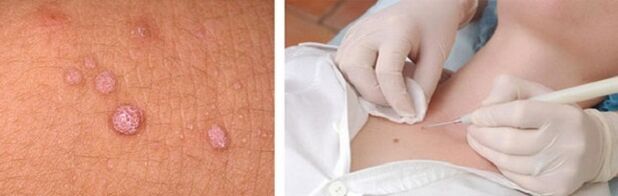
What are the causes of papillomas?
The disease is sexually transmitted in 50% of cases, but may not appear for a long time.Clinical symptoms are observed when the body's immune defenses are weakened, due to colds, inflammation and concomitant chronic diseases of internal organs.
Papillomas on the body most often appear in adolescence, which coincides with the beginning of sexual activity.In young people, the cause may be frequent changes of sexual partners, anal sex.In intimate areas, growths usually form 1-2 months after unprotected sex.
Papillomas are observed much more often in women than in men.Benign formations can appear in the anogenital region and on the mucous membranes of the vagina and cervix.This often causes cancer of the reproductive organs.Due to their weak immunity, young children are susceptible to HPV infection;the virus is transmitted by infected parents during close household contact.
Overweight patients often ask a dermatologist: why do papillomas appear on the body?In people who are overweight, signs of the disease are especially often diagnosed.The reason is a metabolic disorder in the body.The growths are localized mainly in the skin folds of the armpits, groin, under the mammary glands, on the neck, eyelids and face.
Why do papillomas appear on the body, where do they come from?
After entering the blood, the papilloma virus begins to actively multiply, affecting the upper layers of the skin.If the immune system is strong enough, external manifestations of infection may not be observed for a long time.But when favorable conditions are created, pathological proliferation of epithelial cells occurs.
The incubation period does not exceed 3 months, but in some cases the latent course of the disease lasts up to 2 years.The causes provoking the appearance of papillomas on the body are influenza, poisoning, severe stress, acute inflammatory diseases, pregnancy and adolescence.
The main routes of HPV infection:
- From a sick mother to a child during passage through the birth canal.This happens if a woman has papillomas in her intimate areas.The pathogen can also be passed to the baby through breast milk.
- The disease is transmitted sexually from an infected partner to a healthy partner.Using a condom will reduce the risk.But if the growths are located in the perineum or anus, contraception is ineffective.
- The domestic route of infection is through sharing towels and hygiene items.Thus, the virus enters the child's body.
- Autoinfection occurs when a benign formation is damaged by a razor or tight clothing.Growths are appearing elsewhere in greater numbers.
Types and external signs of papillomas
There are more than a hundred varieties of viral manifestations, depending on the type of pathogen:
- Genital wartsOccur on the external genitalia, anus and perineum in both men and women.They have a particular shape, reminiscent of a rooster's comb or cauliflower.There are multiple formations, causing itching and discomfort.In rare cases, anogenital warts are localized on the mucous membranes of the oral cavity, tongue and lips.
- Simple wartsThey are round in shape and most often touch the extremities.Usually, many papillomas appear, the rashes persist for 6-8 months, then they can disappear on their own without any treatment.
- Flat or juvenile wartsoccur in adolescents during puberty against the background of hormonal changes in the body.Usually, these papillomas are localized on the face, neck, fingers and toes on the back.The growths are flat, light pink or beige in color, painless.
- Filiform warts or acrocords- These are elongated formations of light pink or brownish color.Most often, they appear in women under the mammary glands, on the neck, eyelids, face and groin, armpits.
- Plantar wartslocalized on the soles of the feet and inside the hands.The growths cause itching and discomfort when walking.This papilloma looks like a round formation, similar to a callus.In the center there are black dots, along the edges there is a roll of keratinized skin.
- Oncogenic papillomaviruseshumans cause the development of cancer of the larynx and genitals in women.
Treatment of facial and body papillomas
In most cases, skin tags do not cause discomfort and do not require treatment.Exceptions include formations that are constantly injured and have cosmetic defects.
There is no complete cure for the HPV virus, but maintenance treatment can help prevent skin growths from appearing.It is useful for an infected person to adhere to a proper diet, exercise, carry out health procedures and give up bad habits.
To begin with, it is best to treat the papilloma virus with topical medications.
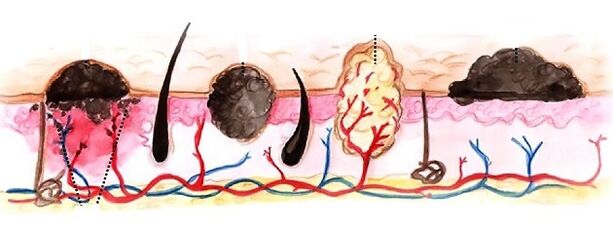
If no positive changes are observed after taking the medications, the growths are surgically removed.But without prior restorative therapy, such a procedure is ineffective, as relapses may occur.First of all, it is necessary to carry out treatment to increase the body's immune defenses.The patient takes immunomodulators, vitamin complex, antiviral and cytotoxic drugs.If there are concomitant diseases, the source of inflammation must be treated.
Surgical method of treatment
It is necessary to surgically treat the pathology if the diameter of the papilloma exceeds 1 cm, if a cancerous tumor is suspected.The doctor removes the growth along with a small amount of surrounding tissue.Then cosmetic points are applied.
Alternative methods for treating papillomas of the face and body are:
- Cryodestruction– this is the effect on the neoplasm of low temperatures (-196°).The procedure is painless and does not require the administration of anesthetics.After treatment with liquid nitrogen, the shoot turns white, then a blister forms in its place.Little by little, the pathological cells die.This method makes it possible to treat papillomas of the neck, eyelids, intimate areas and other areas with sensitive skin.
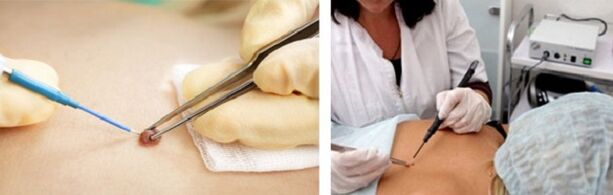
- Electrocoagulation– this is the effect of high frequency currents on the affected area.A special ring is placed on the narrow stem or base of the growth, which cauterizes the tissue.After that, the papilloma is easily removed.No bleeding occurs.
- Laser Removalis the least traumatic method of treatment.The affected area is exposed to a ray of carbon dioxide, the fluid evaporates, the tissues dehydrate, dry out and turn into a dark crust, which falls off after a week.When removing papillomas on the eyelids and face, it is necessary to avoid contact with ultraviolet rays on the skin, otherwise pigmentation may occur.
- Radiosurgical treatmentcarried out using a special device.The therapy method is similar to laser cauterization, except that in this case a radio knife is used.After removal, no scar remains.
- Chemical destruction methodis carried out by applying organic acids to the surface of the papilloma, which destroy the structure of pathological cells.
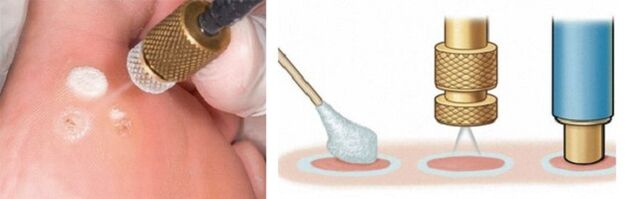
If the pain threshold is low or the growth is significant, local anesthesia is used.After the operation, the patient must follow the doctor's recommendations and carry out disinfection.The excised papilloma is sent for histological examination to exclude the presence of cancer cells.
Relapses after surgical treatment occur if the affected area is not completely treated.In this case, growth reappears.
Removal of genital warts
Before the procedure, a person must undergo a biochemical blood test for the presence of antibodies to the HPV virus, smears for urogenital infections and a tissue biopsy.Based on the research results, the doctor selects the optimal treatment option.
Anogenital warts are removed using the same methods as papillomas of the neck and face.These are cryodestruction, laser radiation, electrocoagulation, radio wave therapy, chemical destruction.
All patients are recommended to treat papillomas of the intimate area, as they can infect their partner with the virus.And growths on the vagina and cervix in women require urgent excision because they can cause cancer.
Human HPV prevention
The only way to prevent papillomavirus is vaccination.In some countries, this measure is included in the list of obligatory vaccinations, in others the procedure is carried out at the request of the patient.
Vaccine injections take place in 3 stages, with an interval of 1 month and six months after the first injection.Scientific studies have confirmed the effectiveness of this method, which eliminates the causes of benign formations on the skin.
Additional preventive measures include protected sex, careful selection of a sexual partner, strengthening the immune system, improving the health of the body, using personal hygiene items and timely treatment of infectious diseases.
A dermatologist can answer the question of why papillomas develop and how to treat them.The doctor will conduct an examination, prescribe laboratory tests and select the necessary treatment regimen.